Proteus
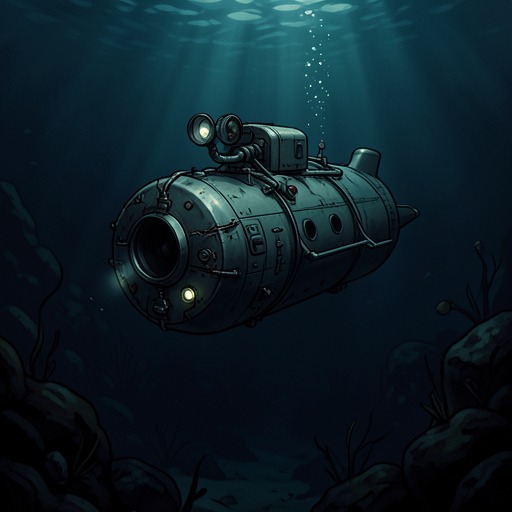
The TrenchProteus is a four-person deep-sea submersible lost during a Geo-Tech Industries expedition into the Mariana Trench. Its mission to survey the canyon floor and investigate hydrothermal vents ends in the deaths of its crew, but the loss also alters the schedule of Geo-Tech Industries’ larger operation and becomes the focus of conflicting accounts. First presented as an accident attributed to pilot error, the destruction is later understood in the context of unexplained sonar contacts and predatory life-forms in the trench.
Design and Mission
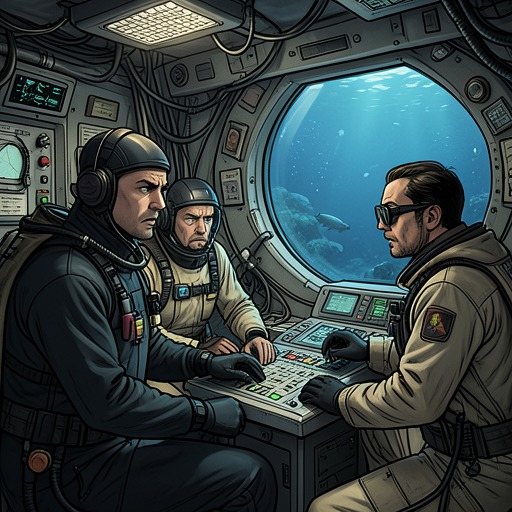
On March 22, 2001, retired Navy deep-sea pilot Barry Leace operates Proteus at a depth of 34,718 feet, beneath nearly seven miles of water and about 16,000 pounds per square inch of pressure. Its interior is cramped, packed with monitors, electronics, and wiring; the pressurized hull leaves little space for the crew. The sub’s design makes it a working instrument for a dangerous environment, but also underscores how dependent its occupants are on the integrity of its enclosure.
Proteus operates in support of the Benthos, Geo-Tech Industries’ mobile deep-sea laboratory and docking station. The sub has moved too far ahead of the larger vessel, frustrating project leader Ellis Richards, who is concerned about the schedule. Leace, by contrast, resists taking risks merely to make up time. His caution is grounded in the immediate circumstances: the Benthos is behind, surface communications are disrupted by severe weather, and the crew has no reliable way to know how quickly an unknown life-form might approach. The disagreement establishes the mission’s central tension: scientific and commercial urgency pressing against the limits of safe operation.
The team is investigating hydrothermal vents whose plumes have remained active since the Cretaceous period. After Leace uses the lateral thrusters to bring Proteus down between black smokers, the sub hovers above tube worms while the crew prepares to collect samples. Arie Levy starts gas chromatography detectors to search for helium isotopes that might shorten the mission. Richards operates the robotic arms, guiding a pincer toward the sampling equipment. Proteus is thus not simply transporting the expedition: its ability to hold position, collect material, and search the seafloor is essential to what the project hopes to learn.
Sonar Contacts and Destruction
During the operation, sonar reports three unidentified objects approaching at fifteen knots, with no response from the surface. The contacts make Leace’s earlier caution newly consequential: the sub is isolated, and the threat’s identity and speed remain uncertain. The evidence does not establish exactly what the objects are at the moment of detection, but the crew’s situation changes from a controlled sampling mission to a potential encounter without outside support.
The sub’s hull integrity begins to fail. A powerful impact strikes its bow and throws crew members from their positions; Leace hits the viewport, then sees a luminous red eye outside the glass. The eye gives the danger a visible form, after sonar has registered it only as an approaching presence. Proteus is struck again, and the crew faces the immediate prospect of the pressure hull giving way. The sub implodes, killing all four people aboard.
The loss is also a practical setback. Proteus had been designed to conduct a thorough search of the canyon floor, while Geo-Tech Industries did not yet know the precise location of the fusion fuel it sought. Its destruction therefore adds months to the company’s timetable. The sub’s absence is not merely a casualty count: it removes the expedition’s means of systematically searching the trench at a pivotal stage of the larger project.
The Accident Record
Proteus’s fate remains present in the story through its recorded acoustic signature. Terry Taylor and a sonarman identify a 42-hertz sonar sound as belonging to the sub. The recording, catalogued as having been made shortly before the implosion, continues for seven minutes and forty-seven seconds of silence before the detonation is heard. The interval turns the recording into a stark record of an approaching catastrophe: the familiar signature is there, then disappears, and the final sound confirms the loss.
The official explanation differs sharply from what the crew encountered. In a report to JAMSTEC, Terry states that the sonar records show nothing unusual before Proteus loses hull integrity and attributes the accident to piloting error, possibly after its starboard bow plane struck a black smoker. She also says that no other vessels or predatory life-forms were involved, and asks that the UNIS project continue. Later, when Benedict Singer refers to the report, Terry’s earlier account stands in contrast with her recognition that the creatures may have attacked Proteus and consumed what remained of its crew. The report therefore becomes part of the cover surrounding the expedition’s danger, rather than a complete account of it.
Strategic Consequences
The loss also has an intelligence dimension. Mossad had placed an operative aboard Proteus to discover the source of the fusion fuel, but the sub implodes before the agent can transmit the information. The deaths and the failure of communication leave a critical question unresolved for those trying to monitor Geo-Tech Industries. At the same time, the later explanation makes clear that Benedict Singer entered the Mariana Trench without knowing the fuel’s exact location; Proteus’s assigned search was meant to resolve that uncertainty.
The accident becomes an instrument in a wider struggle over access to the trench. Richard Diefendorf tells Jonas Taylor that Singer wants him to meet about the Goliath immediately after receiving word of the implosion. Later, the investigation of Proteus is described as an attempted means of forcing Singer out of the trench before he can locate the manganese nodules. Terry’s report, which speaks favorably of Geo-Tech Industries’ activity, undermines that effort. In this way, the sub’s loss produces consequences beyond the expedition: its official explanation affects who can remain in the trench and who may reach the resources there.
Narrative Significance
Proteus makes the material limits of deep-sea exploration central to the plot. Its instruments allow the crew to approach vents and gather evidence, but sonar cannot identify the approaching objects, surface communication fails, and the pressure hull cannot protect the crew from the force outside it. The vessel embodies both the promise of technical access and its dependence on conditions that the explorers cannot fully control.
Its destruction also anchors competing versions of the same event. The acoustic record, Terry’s report, the crew’s encounter, and the later intelligence disclosures each reveal different parts of the loss. The result is a recurring contrast between what an official document can claim and what the expedition’s evidence implies. Proteus is consequential not only because its four crew members die, but because its disappearance delays the search, conceals information, and helps shape the political and commercial contest over the trench.